The story of SPACE for Play: A framework for building community at work, team connection and growth through structured play
In 2024, I got fired.
Sucks. Seemed like it was happening to everyone at the time.
I wasn’t even shocked. My emotions were so deadened because I was burnt out. When I finally came to, at first, I thought about leaving tech forever, like so many women in their 30s do.
But I couldn’t leave. I loved tech. More than that, I loved the people in it. And I kept thinking about the teams where work didn’t feel like this–the ones where I’d felt alive.
The teams I’d lost
I hadn’t always felt this way.
Since the start of my career, I’d been part of extraordinary teams (I just didn’t know it then). I was lucky we had leaders who trusted us to solve problems, ask questions, and make an impact.
But what truly set these teams apart wasn’t the autonomy; It was the psychological safety we built over time. We pulled the best out from each other because we felt safe enough to be honest, vulnerable, and wrong.
And in every one of those teams, it felt like I’d known those folks my whole life. Together, we were building community at work through play.
It came in many forms. We played card games over lunch and aimed NERF guns at each other over cubicle walls in the afternoons. It manifested as playful check-ins in meetings, giving us space to understand how each of us were showing up that day. We took time to do arts & crafts, if you can believe it, making grimoires out of rice krispies and tying it back to work (or not!). It was this curiosity over perfection which let me bring my–at the time–kind of out there activities and exercises to our workflows and workshops. My teams gave me permission to be human, not just productive.
I didn’t realize how rare this was until I lost it.
What happens without play
Then I joined teams where play wasn’t welcome.
Whenever I suggested even a small playful check-in, eyes would roll. Asking something as simple as “how are you really doing?” felt unprofessional. Everyone was too overworked, too siloed, or too exhausted to try anything new or lean in.
I still tried. Oh boy, I tried. But without play, and the connection and trust that came with it, I couldn’t do my job the way that worked best for me. I couldn’t collaborate. And I sure as hell couldn’t pull from people’s minds when they wouldn’t give me the chance.
Eventually, I burned out. Despite being an introvert, I still needed the support, safety, and connection a great team provides.
At one point, I gave up. Every day became the same. Every morning, a slog, stuck in perpetual Mondays. I was without purpose, moving pixels on a screen for a paycheck.
When I got let go in 2024, I thought: maybe this is it. Maybe it’s time to leave tech entirely.
The numbers don’t lie
Turns out I wasn’t alone.
68% of employees are disengaged at work. 84% of tech workers report burnout. Those aren’t just statistics. Those numbers represent people, like me, who love what they do but can’t thrive how they’re doing it.
Culture was changing, and for the worse.
But I couldn’t leave. I loved my friends working in tech. I loved the work itself. I wanted to create a better world for them and for all of us.
What I already knew
Here’s the thing: I’d been watching this pattern of play emerge for over a decade.
As a UX designer and facilitator, I’d run hundreds of workshops. I’d designed serious games for at-risk youth, where play created safety for vulnerable conversations on topics like privilege. I’d studied the research, like Amy Edmondson on psychological safety, Stuart Brown on play science, the neuroscience of connection and creativity.
I knew play worked. I’d seen it create trust on teams easily. I’d watched playful check-ins turn hostile meetings into collaborative ones. I’d used games to help people practice difficult skills in low-stakes environments. Play just naturally creates the type of environments where we feel safe to experiment again and try on new things, the way we did when we were kids.
But I’d never tested it systematically. I hadn’t sat down and made the time or gave myself the space to reflect and figure out the exact conditions that made play so powerful.
So I decided to find out.
The experiment
I wanted to understand: What actually creates those great teams? Could I isolate the conditions and test them?
So I designed an experiment. I’d create a space where psychological safety, play, and connection were intentional, a place where I could test what worked before bringing it to the messy reality of workplace teams.
I called it The Party, a wink and a nod to adventuring parties in role-playing games like Dungeons & Dragons, and party lobbies in multiplayer games. I defined “party” as: a chosen team, each on their own path, traveling together, learning, stumbling, supporting each other, and celebrating the journey, side by side.
It started with a few friends and grew to 14 members over 5 months, from July through November 2025.
We eased in. Every day, I posted low stakes questions as an easy way to practice self-awareness, creativity, vulnerability, and other soft skills, a chance to share and get to know more about folks
take a moment to be present, daydream, be silly, and connect with other party members. You never know who might really need to hear what you have to say.
Examples included:
“Draw a fantasy sword using a post-it note. Tell us about its made-up background.”
“If your current project was a D&D character, what would it be?”
“Share your emoji mood for the week ahead.”
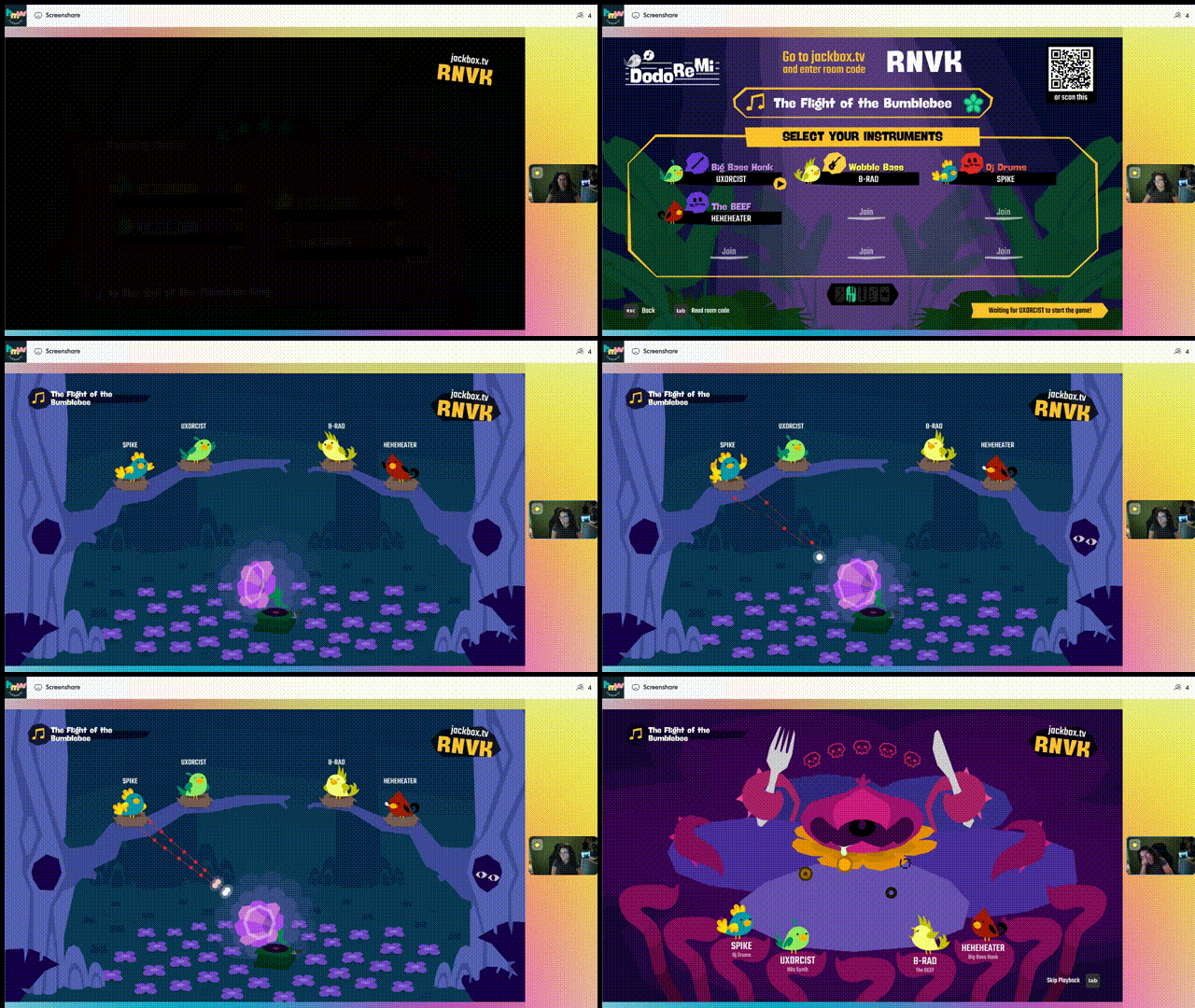
I hosted remote coworking sessions and facilitated workshops on tough topics like rest as rebellion and more laid back topics, like a book club. And I created space for us to play together, make connections, and develop skills using digital, card, improv, and role-playing games. Think Jackbox games for creativity, This Discord Has Ghosts in It for storytelling, Keep Talking and Nobody Explodes for communication under pressure.
The data told a story…
After 5 months, party members reported a 74% improvement in their sense of connection, up from an average of 2.3/5 to 4.0/5.
100% said they would recommend play-based practices to their own work teams.
78% reported increased energy and motivation at work.
Party members improved in an average of 7 different soft skills, with empathy and active listening topping the list at 67% each.
The stats proved it worked. But the testimonials showed me why it worked:
“I really enjoyed the safe place built for communication and community. I liked having a place where others understood the struggles of working environments and allowed me to express them in ways that wouldn’t affect my job.”
“Connecting with others and feeling less isolated or lonely. I really only talk to my family throughout the workday. During work, it’s just me alone at my desk for most of the day. It was great to be able to take breaks and connect with others going through the same things.”
“Using play that is fun and not like usual boring team building stuff like ice breakers and chicken, dog, boat scenarios lol! Those things have their place but they are out of touch and boring and could use a revamping.”
“Focus was on the play, not my effectiveness or productivity. Felt safer to be a bit vulnerable.”
The pattern I kept seeing
Here’s what I learned: When you give people safety and choice, they show up.
We had clear agreements about respect, accountability, and confidentiality. I invited people to participate however felt right, meaning cameras on or off, PJs or casual, all made up or goblin style, voice or text, early, late, or not at all. There would always be another session.
TL;DR: you do you, boo.
And what happened? People chose to show up. For themselves and for each other. For play!
It was the kind of culture I missed. The kind I wanted tech teams everywhere to experience.
At the end of 5 months of events, community moderation, relationship building, running games, discussions, and workshops–oh my!–It clicked. I finally understood what made those great teams work.
And I knew now exactly how I could help other teams connect, too.
The framework: S.P.A.C.E. for Play
I call it the SPACE for Play framework. Cue 2001: A Space Odyssey.
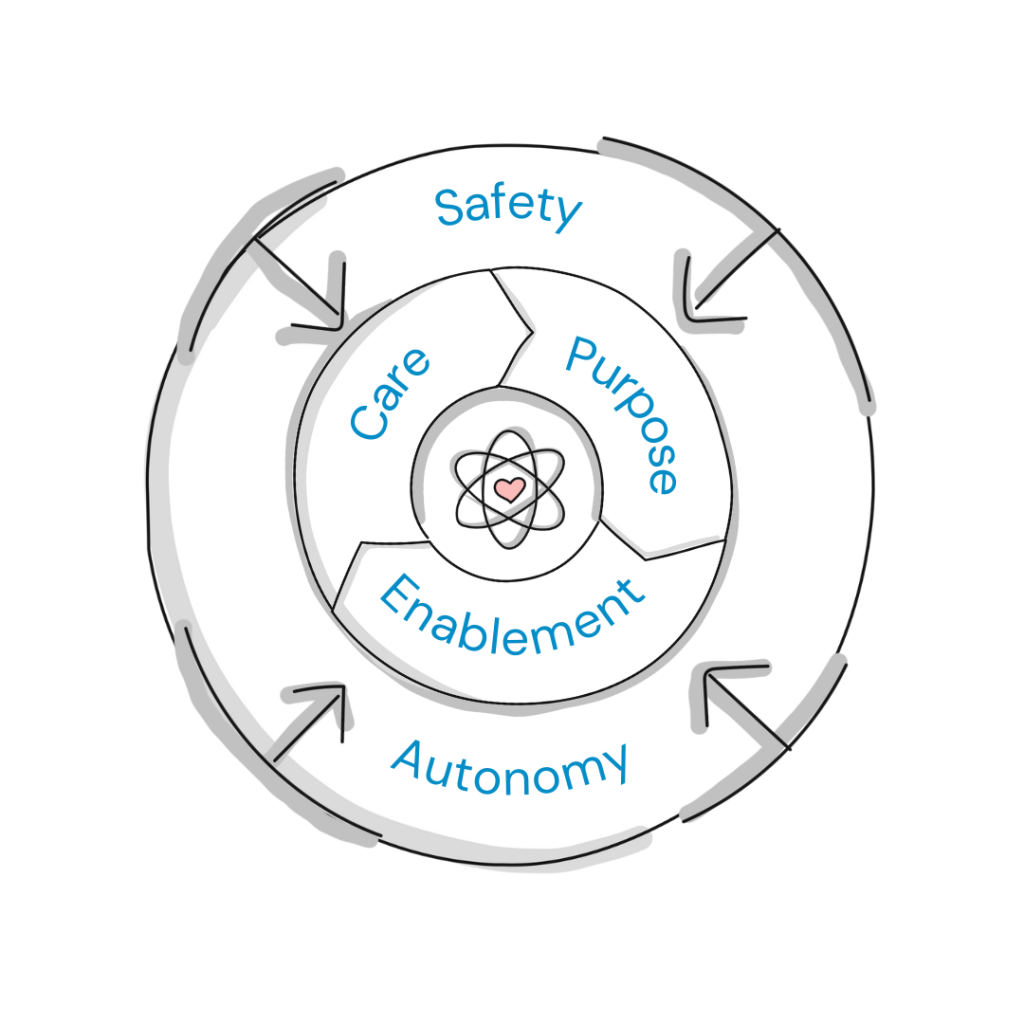
After 5 months of running The Party, I saw the pattern clearly. All those years of facilitation, all that research on psychological safety and play science, all those teams where connection happened naturally–it all clicked into place.
This framework isn’t something I invented. It’s something I discovered and synthesized, watching what actually works, over and over, across hundreds of workshops and all of my experience with great teams (and not-so-great teams).
SPACE for Play is made up of five elements: Safety, Purpose, Autonomy, Care, and Enablement.
Safety: The Foundation
You know that feeling when you have an idea in a meeting but don’t say it? When you see a problem but stay quiet? When you’re struggling but say “I’m fine”?
That’s what happens without psychological safety.
Harvard researcher Amy Edmondson defined it as “a belief that one will not be punished or humiliated for speaking up with ideas, questions, concerns, or mistakes.” But it’s not just that. It’s also feeling safe enough to be human at work and everything that comes with being human, like feelings, ETC.
In The Party, we built safety through clear agreements. Everyone knew what was expected, what our values were, and what wouldn’t be tolerated. Simple. Transparent. Safe.
Studies find that psychological safety in teams is linked to higher engagement, lower stress, and lower turnover. Sounds nice right? That’s because safety is what lets people breathe.
Without safety, nothing else in this framework works.
Autonomy: Different Strokes for Different Folks
Once people feel safe, they need freedom to choose how–and if–they participate.
In The Party, we welcomed folks to engage however felt right. Some came ready to play fully. Others watched from the sidelines. Others didn’t participate at all, and that was okay.
When people have autonomy over how they engage, they’re more likely to engage authentically. Autonomy is as important as safety. These two create the foundation for everything else.
Care: Remembering We’re Real People
Safe, autonomous spaces allow people to care for each other.
Care means remembering we’re all people with intricate lives, feelings, and struggles. How are you feeling? What’s scaring you this week? How can I help?
In The Party, all our meetings started with check-ins to see how people were feeling and provide space to understand where others were coming from.
Purpose: Injecting Play Into the Everyday
Now we’re ready for purpose, injecting fun and playfulness into everyday things like standups, retros, presentations.
Work doesn’t need to be serious all the time. We’re ready to participate in playful things because we remember how it felt to play as children. It felt safe, optional, and caring – a judgement-free zone to try things out and discover what works for you.
Purpose isn’t about adding more meetings. It’s about using the ones you already have to create an open door, a hand outstretched to join as you are and engage in the magic circle.
Dr. Stuart Brown, founder of the National Institute for Play, emphasizes that “the opposite of play is not work—the opposite of play is depression.” Play is how we stay connected to ourselves and each other.
Enablement: Structured Practice for Growth
The last element is enablement: using structured play to develop specific soft skills.
This isn’t old-school team building with trust falls and ropes courses. This is about developing the folks on your team so the work gets better as a side effect, because the wellbeing and growth of your team increases.
For example, in The Party, we used For the Queen to practice collaboration and vulnerability. We used Peak for emotional intelligence and teamwork.
Each game creats a low stakes lab where people can practice difficult skills without work consequences.
When teams practice in low stakes environments, something shifts. They get better at navigating tension, communicating clearly, trusting each other. This is the kind of thing that play naturally beats out training for. It’s like a simulation where teams practice being human together.
Why this order matters
You’ll notice I didn’t explain these in S.P.A.C.E. order. That’s intentional.
While the acronym helps you remember all five elements, they build on each other in a specific sequence:
First, safety. Without it, nothing else works.
Autonomy follows. When people feel safe, they need freedom to choose, which makes them feel safer.
Care develops next. Safe, autonomous spaces allow people to care for each other.
Purpose emerges. Once you have safety, autonomy, and care, you can embed play into regular rhythms, using it purposefully.
Enablement caps it off. Now you’re ready for structured games that develop specific capabilities.
Think of it like a relationship. You don’t start by asking someone to be vulnerable (enablement). First, you create safety. Then autonomy. Then care. Then shared rituals (purpose). Then growth (enablement).
Teams are relationships. The sequence matters.
What this means for building community on your team
Here’s what makes The Party such strong proof: these were tech workers who didn’t work together. They didn’t have shared deadlines or projects depending on their collaboration. And no manager forcing them to participate.
They chose to show up. And when they did, connection and psychological safety flowed because the conditions were right.
Now imagine applying this framework to people who do need to collaborate, who have shared goals, existing relationships, and real work that depends on trust.
100% of Party members said they’d bring play-based practices to their work teams. But…78% said they’d want someone else to facilitate it.
Why? Time. Energy. Not knowing how to start when you’re already burned out.
That’s the gap I fill.
What’s possible
The best teams don’t hope collaboration happens. They create the conditions where it thrives.
That’s what S.P.A.C.E. for Play does. It’s not magic. It’s not complicated. It’s systematic. It’s intentional. And it works.
You don’t need to implement all five elements at once. Start with safety. Add autonomy. Build from there.
Or don’t start alone! That’s what I’m here for.
I’m looking for pilot teams to test this framework in early 2025—teams who want to build psychological safety, practice being human together, and prove that work doesn’t have to feel like burnout.
If that’s you, let’s talk.
Because the people in tech deserve better. And I think we can do it together.
Lissy is a UX designer and facilitator who’s spent 10+ years integrating play into workshops, designing serious games, and studying the science of psychological safety. She created S.P.A.C.E. for Play by systematizing what she’d learned across hundreds of teams—then validated it through The Party, a 5-month experiment that helped 14 tech workers improve connection by 74%. She’s currently looking for pilot teams to help refine and scale the framework.